Chargeable Weight Calculator: free, for air, courier, road, rail & ocean
Type in your pieces or let AI read your packing list. Get volumetric and chargeable weight per piece and per shipment: instantly, no signup.

Volumetric and chargeable weight for every transport mode
The calculator applies the right conversion for each mode and clearly shows which value is billed, per piece and for the whole shipment.
All transport modes
Air freight (IATA 1:6000), courier and express (1:5000), road (1:3000), rail (1:2000) and ocean LCL (W/M, 1 m³ = 1,000 kg), plus a custom divisor for deviating carrier contracts.
AI document extraction
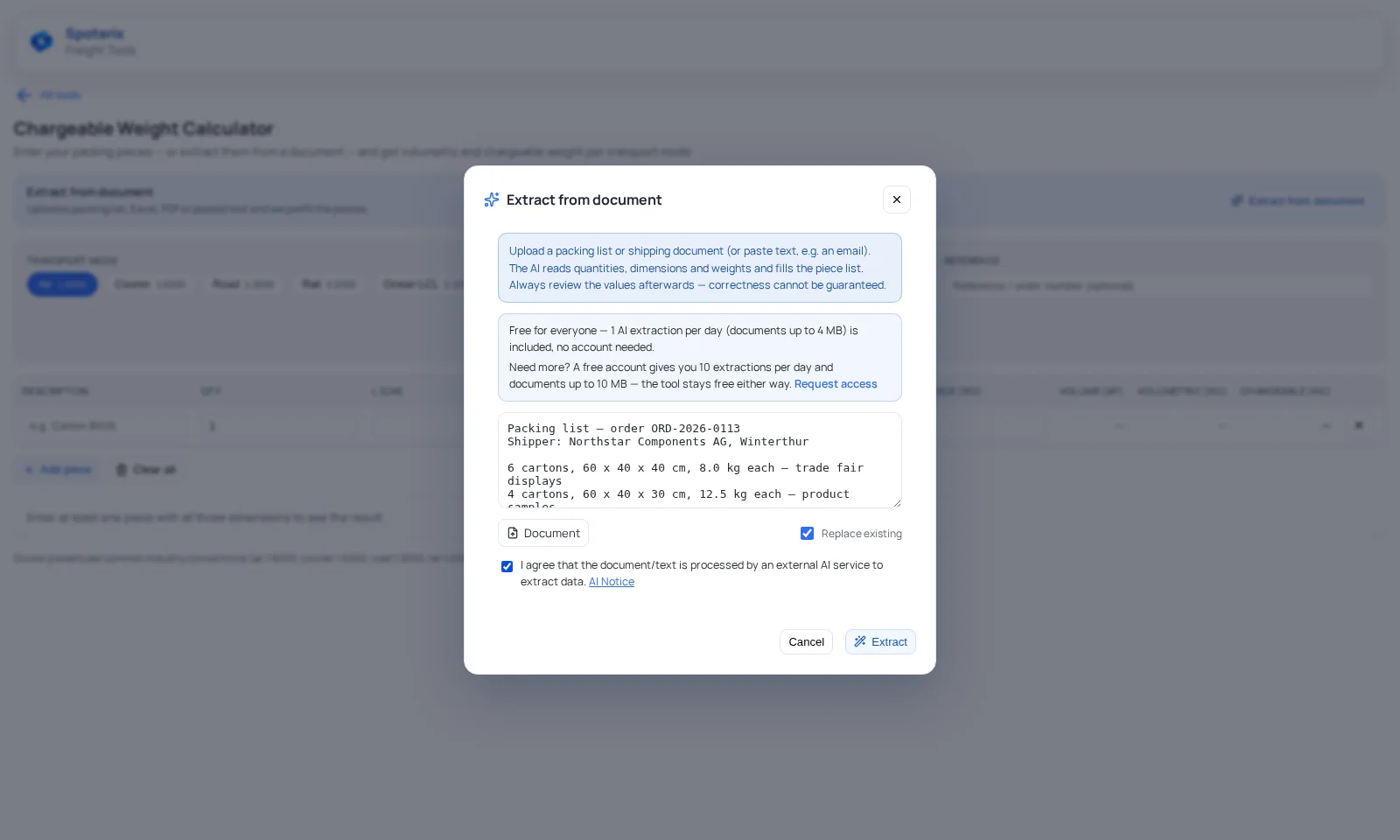
Paste a packing list, email text or upload Excel and PDF files. Quantities, dimensions and weights are recognized automatically and stay fully editable for your review.
Per piece and per shipment
Volume, volumetric weight and chargeable weight for every line. The billing decision is made correctly on the shipment totals, with a clear marker for the value that governs.
Metric and imperial
Work in cm and kg or in inches and pounds. Values are converted automatically when you switch units.
Free, no signup
The calculator is completely free to use. AI extraction includes one extraction per day without an account and ten per day with a free Spoterix account.
No data storage
Calculations run in your browser. Uploaded documents are processed only to extract the pieces and are not stored.
How the chargeable weight calculator works
From packing list to billable weight in three steps.
Enter or extract your pieces
Type in dimensions and weights, or upload a packing list, PDF or Excel file, or paste email text, and let AI recognize the lines.
Select the transport mode
Air, courier, road, rail or ocean LCL, or set your own divisor according to your carrier contract.
Read the result
Volumetric and chargeable weight per piece and as a shipment total, clearly marked which value is billed.

What is chargeable weight and how is it calculated?
The definition, the formula and the divisors behind the calculation.
Chargeable weight is the weight a carrier actually bills: the higher of the actual gross weight and the volumetric weight of a shipment. Carriers charge the higher value so that light but bulky freight pays fairly for the loading space it occupies.
Volumetric weight (kg) = length × width × height (cm) ÷ divisor. The divisor depends on the transport mode:
| Transport mode | Common convention | Meaning |
|---|---|---|
| Air freight (IATA) | 1:6000 | 1 m³ counts as 167 kg |
| Courier and express | 1:5000 | 1 m³ counts as 200 kg |
| Road freight (Europe) | 1:3000 | 1 m³ counts as 333 kg |
| Rail freight | 1:2000 | 1 m³ counts as 500 kg |
| Ocean freight LCL | W/M (weight or measure) | 1 m³ counts as 1,000 kg; the higher value is billed |
These divisors are market conventions, not binding standards. Individual carriers and forwarders calculate differently, for example road freight at 1:4000 or loading-metre rules. Use the custom divisor for such contracts; the freight contract always remains authoritative.
Worked example: the transport mode can flip the result. Take four cartons of 60 × 40 × 30 cm, each weighing 12.5 kg. The shipment has an actual weight of 50 kg and a volume of 0.288 m³. As air freight (1:6000) the volumetric weight is 48 kg, so the actual weight of 50 kg governs and is billed. The same shipment by courier (1:5000) has a volumetric weight of 57.6 kg; now the volumetric weight governs and 57.6 kg are billed.
Measuring rules, break-even densities per mode, further worked examples and invoice checks are covered in the Knowledge Base guide How to calculate chargeable weight.
Free to use, with or without an account
The calculator itself is always free. A free Spoterix account raises the daily limit for AI document extraction.
Everything you need, no signup
- All transport modes plus the custom divisor
- Volumetric and chargeable weight per piece and per shipment
- Metric and imperial units
- One AI document extraction per day
Calculations run in your browser and uploaded documents are not stored.
More AI extractions per day
- Ten AI document extractions per day instead of one
- The calculator itself stays free either way
- Access to the Spoterix freight procurement platform
Does the shipment actually fit?
Chargeable weight answers the price side. Whether the pieces physically fit into a container, trailer or air freight pallet is a job for the free Spoterix 3D Load Calculator.
Chargeable weight questions
Answers to common questions from freight, procurement and logistics teams.
What is chargeable weight?
Chargeable weight is the weight a carrier bills for a shipment: the higher of the actual gross weight and the volumetric weight. It ensures that light but bulky freight pays fairly for the loading space it occupies.
How do I calculate volumetric weight for air freight?
Multiply length × width × height in centimetres and divide by 6,000 (IATA convention). Example: 100 × 80 × 60 cm ÷ 6,000 = 80 kg volumetric weight. If that value is higher than the actual weight, it becomes the chargeable weight.
Why do couriers use 1:5000?
Courier and express networks move densely packed parcels through standardized aircraft and vehicle space, so they apply a stricter conversion of 1:5000: one cubic metre counts as 200 kg instead of the 167 kg used in classic air freight.
What is W/M (weight or measure) in ocean LCL?
In LCL ocean freight the rate is applied per tonne or per cubic metre, whichever is higher (weight or measure). One cubic metre is equated with 1,000 kg, so a shipment of 2 m³ weighing 900 kg is billed on 2 units.
Is my data stored?
No. Calculations run in your browser. If you use AI extraction, the uploaded document is processed only to recognize the pieces and is not stored.
Is the calculator really free?
Yes. The calculator is completely free and requires no signup. AI document extraction includes one extraction per day without an account and ten per day with a free Spoterix account.